
 EN
A flashlight aimed across a dark field can throw a spot a hundred metres away; a fixed ceiling lamp in a room lights only the floor beneath it. Nobody concludes that the flashlight is the more capable product. Yet the same confusion drives the common warehouse question: high bays are said to "cover more area" than floodlights, as though coverage were a property baked into a product category. It is not. High bays dominate warehouses because the building's geometry — tall ceilings, high racking, narrow aisles, labels read at height — rewards a downward, controlled, high-intensity distribution mounted close to the work. Floodlights are directional tools built for a different target geometry. This article works through the mechanism: geometry, optics, standards, specification, and the cases where a floodlight is genuinely the right answer.
1. The analogy: a flashlight versus a stadium lamp
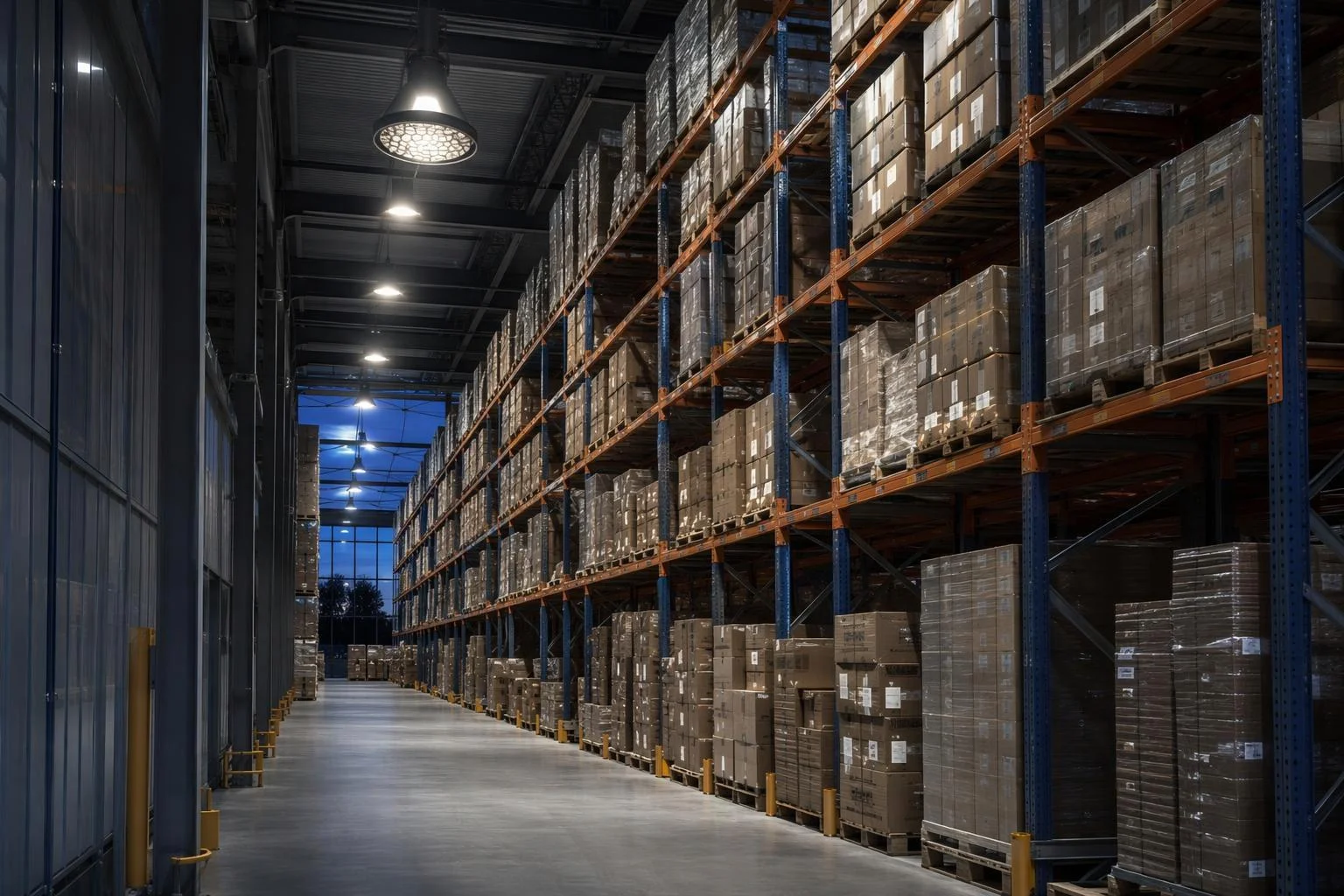
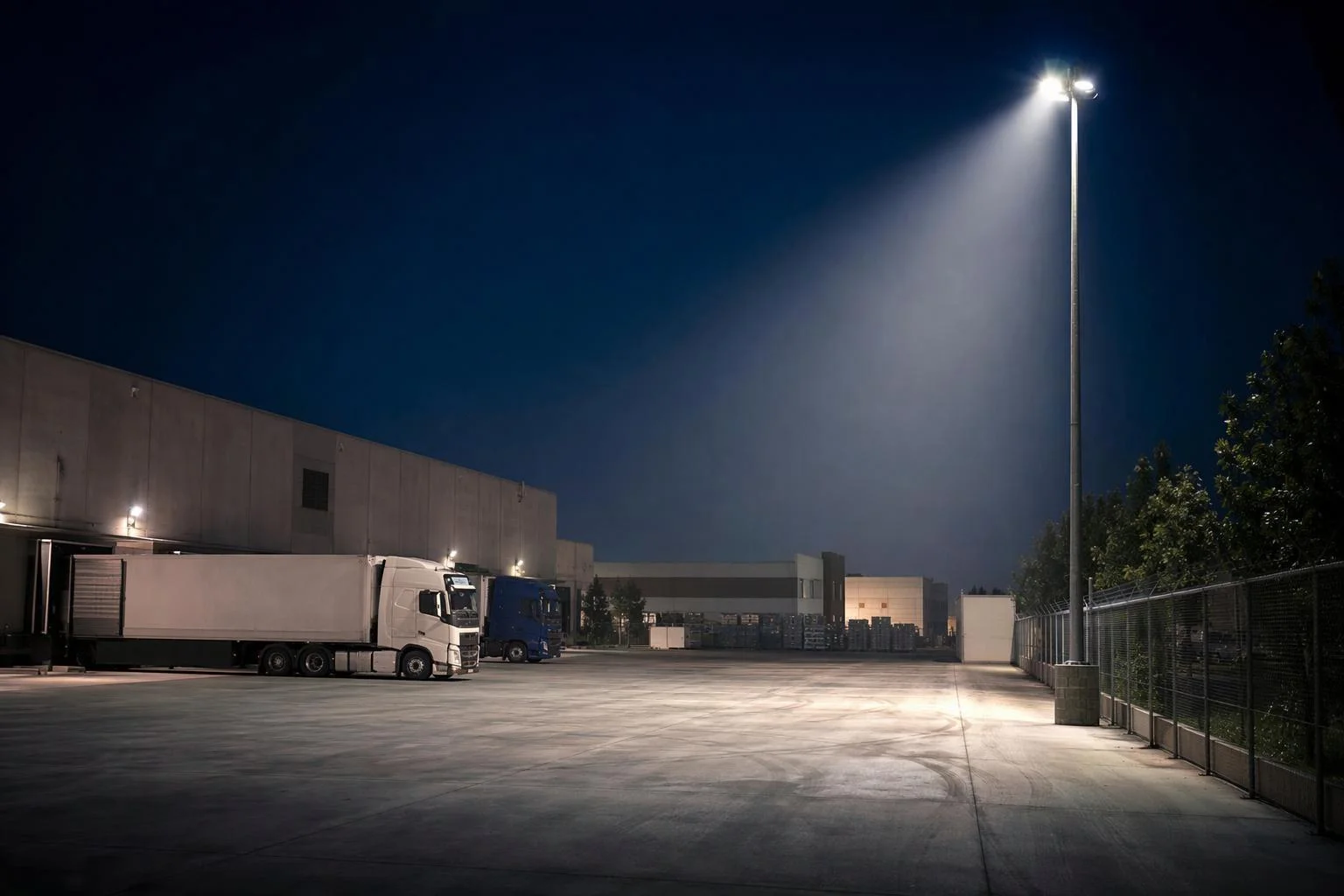
The analogy is illustrative, not a measurement. What it separates is reach — how far a beam travels before it becomes useless — from delivered illuminance on a task surface, the lux that actually falls where someone works. A floodlight on a pole wins on reach: it can push light across an open apron because nothing blocks the path and the target is far away. A high bay wins on delivered illuminance per watt because it sits a few metres above the task and points straight down, so almost every lumen lands on the floor or rack face rather than on the air in between. Coverage, in other words, is a function of mounting position, aiming and beam control. It is not something a product category owns.
2. What actually separates a high bay from a floodlight
The two categories carry different primary-use designations, and those designations describe intended mounting conditions rather than a size ranking. The DLC defines high-bay luminaires as pendant, recessed or surface-mounted fixtures specific to indoor high-ceiling spaces, intended for ceilings of 25 ft (about 7.6 m) or more; a separate high-bay aisle designation covers the same ceiling range where the job is lighting aisles. Floodlights sit under the Architectural Flood and Spot designation: directional luminaires intended to highlight architecture, objects and areas outdoors, with beam spread declared per NEMA guidelines. A floodlight's wide beam is a design choice made for a distant or vertical target. It is not evidence that the fixture is more versatile than a high bay.
3. Why warehouse geometry favors the high bay
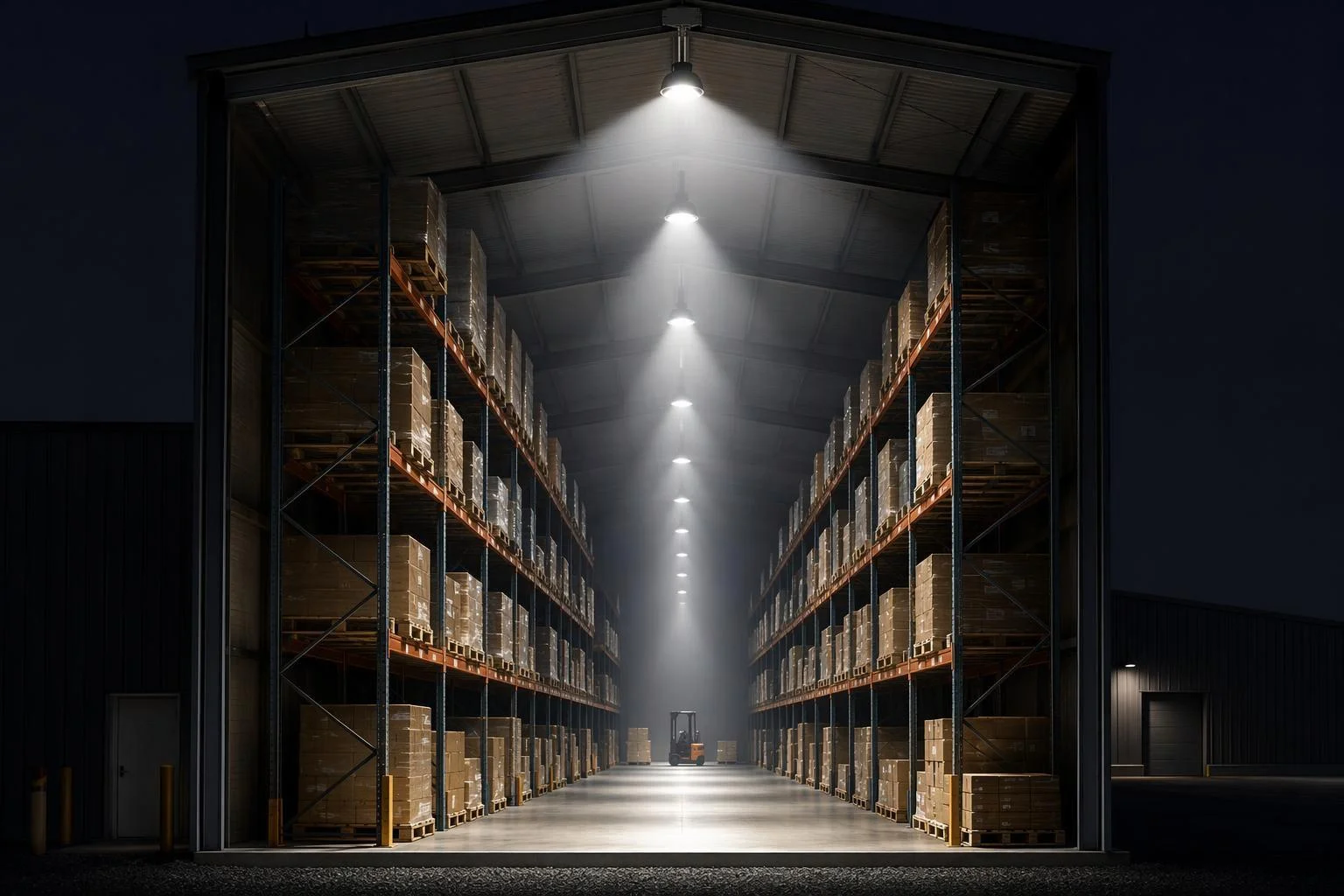
Warehouses are tall buildings with high storage racks and little or no daylight, and the aisles between racks are where light matters most. Glamox's warehouse guidance makes the consequence explicit: for high-bay storage, high vertical illuminance helps workers read labels on goods and racks, and narrow-beam luminaires with reflectors — mountable up to 15 m, with special high-bay reflector types for bays above 6 m — cast light onto the aisles and shelf faces. Wide or asymmetrical beams are preferred only where ceilings are lower and aisles further apart. A downward distribution mounted near the ceiling therefore does two things at once: it puts light on the floor where forklifts run, and it puts light on the rack faces where labels are read, while wasting little on rack tops. That is why the DLC maintains a separate high-bay-aisle designation at all — the geometry is distinct enough to need its own category. The high bay is the default because the building shape matches the fixture's mounting logic, not because it is universally superior.
4. The "floodlights cover less area" premise, corrected
The premise needs correcting rather than repeating. A floodlight's wide beam can spread light over a very large outdoor area from a pole or wall, so it is not accurate to say floodlights inherently cover less area. The real difference is where the light lands and how controllably. A floodlight aimed across an open apron spreads its lumens over distance, and intensity falls with the square of that distance; a high bay concentrates output downward over a defined floor footprint at a short throw. Coverage area also scales inversely with the target illuminance: halve the lux requirement and roughly double the area a given lumen package can serve. A coverage claim with no lux target and no mounting height is therefore not comparable to anything. This is reasoning from geometry, not a measured statistic — but it is enough to show that "floodlights cover less" is the wrong frame.
5. Beam angle, mounting height and spacing: the practical rules
5.1 Start with the spacing-to-mounting-height ratio
The working method starts with the spacing-to-mounting-height ratio, commonly cited as roughly 0.8 to 1.5 depending on beam angle. At a 10 m mounting height with 90° optics, that puts one fixture roughly every 10–12 m in both directions.
5.2 Adjust near walls and between racks
The ratio assumes open, continuous areas; it degrades near walls, where the perimeter row should sit at about half spacing, and it does not apply between tall racks, where fixtures are centred over each aisle and spaced along its length instead.
5.3 Match beam angle to ceiling height
Beam angle follows ceiling height: wide 90–120° optics for lower or open areas, narrower 60–90° or dedicated aisle optics for taller racked spaces. None of this confirms performance — only a photometric layout using the fixture's IES file does that.
6. Illuminance targets: what the standards actually ask for
EN 12464-1:2021 sets maintained illuminance for storage areas, and the warehouse figures are specific: 150 lx on the floor between racks, 200 lx in open goods storage and loading areas, 300 lx for packing and order grouping, all at Ra ≥ 80, with uniformity ratios of 0.40–0.50 depending on the zone and a 75 lx minimum on aisle rack faces. North American practice more often works from IES RP-7 foot-candle targets, which run in a comparable band — roughly 20–30 fc for general warehousing and 15–30 fc at floor level in aisles between 30 ft racks. Two cautions bind either system. These are maintained values, so the day-one design must be divided by a maintenance factor — 0.67–0.70 in dusty warehouses — and uniformity is as binding as the average, since a space that averages 200 lx with dark bands between fixtures still fails its purpose. Exact targets depend on jurisdiction and task.
Maintained illuminance values as tabulated by Glamox from EN 12464-1 for storage and logistics areas. Values are the 'required' column; the same table lists higher 'modified' values for demanding tasks. The rack-face figure is a vertical illuminance on the aisle rack face, not a floor value. Glamox's page does not state which edition of EN 12464-1 the table reproduces, so confirm against the edition adopted in the project's jurisdiction.
7. Specifications that decide a warehouse bid
Procurement turns the mechanism into a checklist. Efficacy in lm/W sets running cost; L70 lumen maintenance sets how long the design holds, and many DLC-listed categories require at least 50,000 hours. IP and IK ratings cover dust ingress and impact in a working warehouse, and ambient temperature tolerance matters in cold storage and hot roof voids alike. CRI matters where label colour is read. Controls readiness — occupancy sensing, zoning, dimming — is where much of the energy saving in a warehouse actually sits, since activity varies between busy hours and near-empty nights. DLC listing and utility rebate eligibility often hinge on these figures, and rebate programmes typically require pre-approval before installation, so filing after the fact can disqualify a project.
8. When a floodlight is the right choice
The honest counter-case is real. Floodlights suit outdoor aprons, yards, facades, sports and parking areas, and indoor high-bay spaces where a directional wash is genuinely needed — a wall of racking lit from an angle, say, rather than a floor. The correct question is never "which covers more" but "which distribution places light on the required surfaces while limiting spill and glare." Aimable floodlights are also treated as field-adjustable light distribution under DLC rules, which affects how they are specified and listed, so a floodlight chosen for a warehouse task should be checked against that policy rather than assumed equivalent to a fixed high bay.
9. Common misconceptions
Three errors recur, and each one costs a project either money or light quality.
9.1 Reusing HID spacing for LED high bays
Metal halide and HPS fixtures had wide, uncontrolled distributions, while LED high bays use engineered optics that throw light very differently, so reusing old pendant-to-pendant spacing usually produces dark spots, hot spots, or both.
9.2 Reading a "covers X m²" table as a design
Such tables assume a lux target that may not be yours, an open clean floor, and no maintenance factor or racking — and they say nothing about uniformity.
9.3 Equating a wider beam with more useful coverage
Mounting height, target illuminance, uniformity and obstruction decide the answer; beam angle is one input among them.
10. FAQ
Q1 Do high bays cover more area than floodlights?
Not inherently. Coverage depends on mounting height, aiming and the lux target; a floodlight on a pole can spread light over a larger area than a ceiling-mounted high bay, at lower intensity.
Q2 Can I use floodlights in a warehouse?
Sometimes, for specific directional tasks, but not as a general high-ceiling default. The DLC's high-bay and high-bay-aisle designations exist because that geometry has its own requirements.
Q3 How do I choose a beam angle?
Match it to ceiling height and rack layout — wider optics for lower or open areas, narrower or aisle optics for tall racking — then confirm with a photometric layout using the fixture's IES file.
Q4 What lux do I need?
Task-dependent. EN 12464-1 gives 150 lx between racks, 200 lx in open storage and loading, and 300 lx for packing; North American projects often use IES RP-7 foot-candle targets instead.
Q5 What specifications matter for a bid?
Efficacy, L70 lumen maintenance, IP/IK ratings, ambient temperature tolerance, CRI, controls readiness, and DLC listing where rebates are involved — with pre-approval before installation.
11. Conclusion: match the fixture to the geometry, not the label
High bays dominate warehouses because warehouse geometry rewards a downward, controlled, high-mount distribution — not because floodlights are intrinsically weaker products. The decision rule follows from that: define the task surface, the target illuminance and the mounting conditions first, then choose the category, then confirm the result with a photometric layout. KEOU Lighting, with 13 years of LED manufacturing experience, supplies both indoor industrial and outdoor fixtures and offers customization against project parameters; whether a specific model suits a given warehouse still depends on its photometry and listing for that application.