
 EN
A supplier's ISO 9001 certificate answers a narrower question than most buyers think it does. It does not tell you whether a downlight will hold its colour point across three shipments, or whether the driver inside it will survive a year of voltage swings. It tells you whether the factory has a documented, auditable system for controlling how that downlight is made — and whether you can inspect that system before you commit to a batch order. That distinction is the whole basis for a fair comparison between a certified LED luminaire factory and an ordinary one.
The criteria below are the ones a buyer can actually verify: certificate validity and scope, incoming and outgoing inspection records, change control and traceability, calibration of test equipment, corrective action, and the difference between a management system certificate and a product-level approval. This is a procurement lens, not a marketing one.
1.0 What ISO 9001 Actually Certifies — and What It Does Not

The ISO/IAF statement of expected outcomes for accredited certification is precise, and worth reading in full before any supplier conversation. For the defined certification scope, an organization with a certified quality management system "consistently provides products and services that meet customer and applicable statutory and regulatory requirements, and aims to enhance customer satisfaction" (ISO/TC 176 Auditing Practices Group).
The same document states plainly what certification does not mean. ISO 9001 defines requirements for an organization's quality management system, not for its products; accredited certification does not necessarily ensure 100% product conformity, and it does not imply that the organization provides a superior product or that the product itself is certified to any standard.
Two further points follow. ISO does not perform certification or issue certificates — independent certification bodies do, and a company cannot be certified by ISO (ISO). And a certificate's meaning is bounded by its stated scope, which is why the scope statement matters more than the logo.
The honest baseline: an ISO 9001 factory is not automatically making a better downlight. It is obligated to have a documented, auditable system for controlling how it makes one — and that obligation is what a buyer can test.
2.0 Certificate Validity, Scope and Coverage
Verification takes about ten minutes and should happen before any technical discussion. Look the certificate up in IAF CertSearch, the global database of accredited management system certifications. An ordinary factory that bought a certificate from an unaccredited body will either not appear there at all, or will appear with a body whose accreditation does not cover your industry. Either case deserves an explanation rather than the benefit of the doubt — and getting that explanation is itself the first real difference between the two supplier types.
Then read the scope statement. ISO/TC 176 guidance is explicit that a certification scope can be smaller than the organization's QMS scope, and gives the lighting-relevant example directly: "A manufacturing enterprise that only chooses to certify one product line from various" — the scope statement would only specify the product included (APG, Scope and Applicability). The same guidance notes that where a process is outsourced, responsibility for the products and services remains with the organization, and the outsourced process should be considered when planning the audit.
Certification is a maintained status, not a one-time badge. Surveillance audits are conducted at least once a calendar year except in recertification years, and the first surveillance audit after initial certification falls no more than 12 months from the certification decision date (ISO/IEC 17021-1:2015, Section 9).
Edition and expiry now matter more than usual. ISO 9001:2026 was published in September 2026, and under the Global ACI transition requirements, new and initial accredited certifications may only be issued to the 2026 edition from 31 March 2028, while organizations already certified to the 2015 edition complete their transition by 30 September 2029 (Global ACI transition requirements). A 2015-edition certificate is not invalid today, but ask which edition and which expiry date the certification body will print.
3.0 Incoming Inspection and Outgoing Inspection Records
This is the first criterion where the two factory types diverge in a way you can observe rather than infer. ISO 9001 requires retained documented information on the release of products and services (clause 8.6) and on the results of monitoring and measurement (9.1.1), alongside control of externally provided processes, products and services (8.4) (documented information summary).
Translated into a request, that means IQC records for LED chips, drivers, housings and diffusers, and OQC records showing the parameters actually measured — luminous flux, CCT, CRI, power and leakage current — together with the sampling plan used to decide the batch passed. An ordinary factory may run the same checks on the line. What it typically cannot do is produce retained records tied to a specific batch you received.
Be clear about what a record proves. It does not guarantee the numbers are good; it guarantees the process is defined and auditable. That is precisely what lets you write acceptance criteria into the contract and hold a supplier to them, because there is a documented baseline to compare against.
4.0 Change Control and Batch-to-Batch Consistency
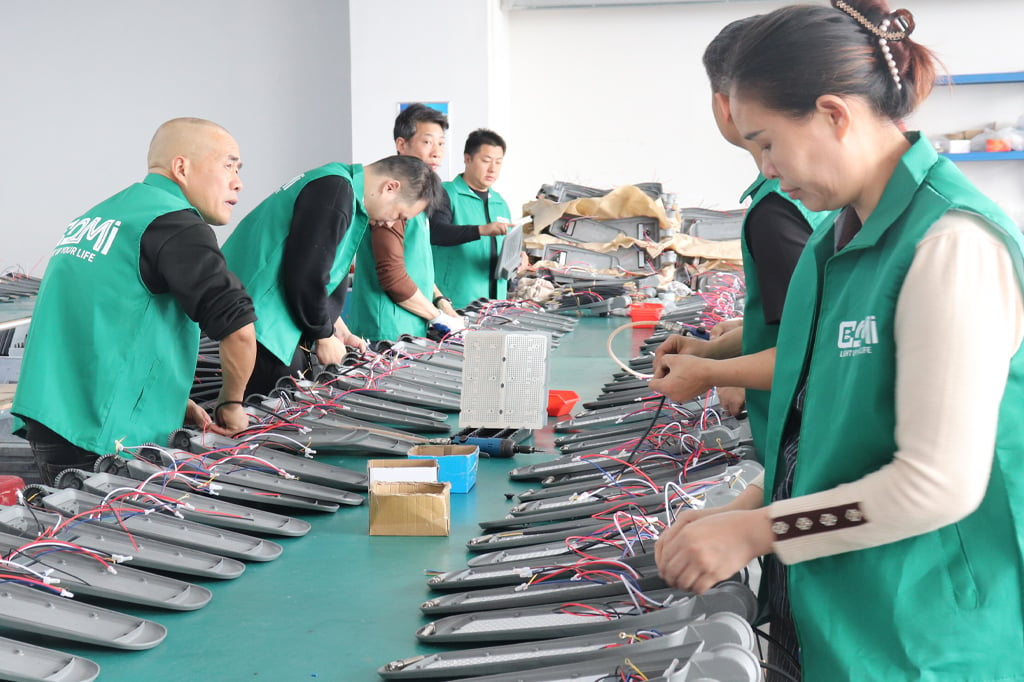
Untracked substitution is the mechanism behind most batch-to-batch variation in LED luminaires, and it is worth understanding at component level. LED packages are binned by flux and chromaticity, so a different bin produces a different colour point and output. A driver's output current and thermal derating govern how hard the LED is driven and how long it lasts. Swap a chip bin, a driver model or a capacitor without a documented review, and the delivered batch can differ from the approved sample in CCT, flux and driver lifetime — differences that show up on a ceiling, not on a spec sheet.
ISO 9001 addresses this directly. Clause 8.5.6 requires retained documented information describing the results of the review of changes, and 8.3.6 covers design and development changes (documented information summary). The comparison is therefore structural: a certified factory is obligated to have a change-control path you can audit; an ordinary factory may substitute silently, and you would have no record to check.
The questions to ask are specific. Request the approved component list with named chip and driver models. Ask what bin tolerances are held for flux and chromaticity. Ask that the driver model be locked to the purchase order. And ask what notification obligation applies before any substitution is made.
5.0 Calibration and Measurement Traceability
A short criterion, but a decisive one. Clause 7.1.5 requires that monitoring and measuring resources be fit for purpose, and that the basis used for calibration or verification be retained as documented information (documented information summary). For a lighting factory, that means integrating spheres, spectroradiometers, power meters and thermal chambers on a calibration schedule, each with a traceable certificate.
An ordinary factory may own every one of those instruments and still not maintain calibration records. The practical consequence is that its reported flux and CCT values cannot be relied on for comparison against a specification — not because the product is necessarily poor, but because the measurement behind the number is unverifiable. That is a procurement risk in its own right, separate from product quality, and it is the reason calibration certificates belong in the same request as the test reports.
6.0 Corrective Action, Nonconforming Outputs and Complaint History
The feedback loop is where a system proves it is alive. ISO 9001 requires control of nonconforming outputs (8.7), retained records of nonconformity and corrective action (10.2.2), internal audit records (9.2.2) and management review outputs (9.3.3) (documented information summary).
For a buyer, the observable difference is whether the factory can show a corrective and preventive action log with root-cause analysis and evidence of closure, and whether field complaints feed back into the process rather than being settled case by case. An ordinary factory may fix a defect without recording its cause, which is how the same failure returns in the next batch.
Ask for a redacted CAPA sample and the most recent internal audit findings. The purpose is not to grade the factory or to score its paperwork. It is to see whether the loop is real — whether a problem found in March changed something in June.
7.0 What the Difference Looks Like Side by Side
Pull the criteria together and the comparison stops being abstract. The table below is what you should expect to observe when you send the same request to a certified factory and to an ordinary one. Nothing in it requires a technical background to check.
|
What you ask for |
ISO 9001 factory |
Ordinary factory |
|
IQC / OQC records for a named batch |
Retained, retrievable, tied to the goods received |
Often on the line but not filed; batch-level retrieval may be impossible |
|
Component substitution |
Reviewed and recorded before it happens; notice obligation in the contract |
May happen silently; you discover it at inspection |
|
Calibration certificates |
On schedule and traceable for sphere, spectroradiometer, power meter, chamber |
Instruments exist, calibration status unclear or lapsed |
|
Nonconformity and corrective action |
Logged with root cause and closure evidence |
Defect fixed; cause unwritten; recurrences likely |
|
Test evidence behind a lumen maintenance claim |
Underlying data set and test duration retrievable |
Figure published; source data often unavailable |
|
Response to an audit request |
Answers in sequence, including the unflattering parts |
Partial answers, then deflection |
Read the table by row rather than as a score. A single weak row does not condemn a supplier, and a strong row does not rescue one that dodges the rest. What matters is the pattern: an ordinary factory typically answers the first question well and the fourth reluctantly, because there is nothing filed to retrieve.
Two practical cautions. First, documentation quality tracks order value — the same factory may keep excellent records for a large OEM account and thin records for a small distributor order, so ask for records on a batch comparable to yours. Second, a certified factory that cannot produce records is telling you something more serious than an ordinary factory that cannot, because it has a system it is failing to use.
8.0 Why a System Certificate Is Not a Product Certificate
The most common category error in supplier evaluation is treating ISO 9001 as a product compliance mark. It is not. Whatever product approvals a market requires — a safety listing, a supplier's declaration of conformity, an energy programme qualification, an LM-80 test report and its TM-21 projection — each one applies to a specific product or component, tested and documented on its own terms. None of them is evidence that the factory can repeat that result twelve months later.
That distinction is where the two factory types actually separate, and it has nothing to do with how many marks appear on a brochure. Both kinds of supplier can put a certified sample in front of you. Only one of them is obliged to hold the process that produced that sample steady.
A certified factory must keep the test evidence, its calibration status and the component identity linked across batches, because an auditor will ask for exactly that link. An ordinary factory can produce a good sample and a good test report and still have no mechanism that ties the next shipment to either. Ask both to prove the link and the difference shows up immediately: one sends a file, the other sends a sample and a promise.
The same logic applies to test claims such as lumen maintenance projections. It is easy to publish a large hour figure; it is harder to show which LM-80 data set it came from, how long that test actually ran, and whether the projection method used respects its own limits. Under IES TM-21, projected values cannot extend beyond six times the total LM-80 test duration — a 10,000-hour test caps the published projection at 60,000 hours (Focal Point Lights, quoting IES TM-21). A certified factory can normally retrieve the underlying data set; an ordinary one often cannot say which lab produced it.
So ISO 9001 sits underneath every product mark as the process layer. It substitutes for none of them. What a functioning QMS does is make the evidence behind them reproducible batch to batch, rather than a snapshot of the one sample that was sent to the lab.
9.0 Weighing Unit Price Against Defect, Rework and Warranty Cost

The lower unit price of an ordinary factory is real money, and it should not be dismissed. It simply is not the whole cost. What sits against it are the costs the buyer carries when a batch arrives out of specification: incoming rejection and sorting, site rework or replacement labour, freight on replacement shipments, warranty claims, and the administrative cost of a dispute conducted without records.
ISO 9001 does not eliminate those costs. What retained records and change control do is make them attributable and contractible — a measured deviation can be traced to a batch, a component change or a process step, and the remedy can be written into the agreement in advance.
Build the comparison from your own data rather than a supplier's brochure: the defect rate you actually observe at incoming inspection, the labour hours a rework event consumes, the freight cost of a replacement shipment, and the warranty terms each supplier will honour in practice. Where you have no history with either supplier, ask for the last three batches of OQC records and treat the difference in documentation as a risk input.
One honest caveat. For a small, low-risk, short-life order — a single retail fit-out, a sample run, a product you can inspect on arrival — the premium a certified factory charges may not pay back. The calculation changes with repeat volume, project specifications and the visibility of a colour shift to the end user.
10.0 Who Should Choose Which
The choice is conditional, and it turns on your exposure rather than on the certificate alone — which is a fairer way to think about an ISO 9001 LED lighting factory than counting badges.
An ISO 9001 factory is the better fit when you place repeat orders against a fixed specification, when the project requires traceability, when a tender or incentive programme demands documented process control, or when a CCT or flux shift across batches would be visible to the people standing under the light. In those cases the audit trail is doing real work for you.
An ordinary factory, or a non-certified supplier with strong product-level test reports, can be the sensible choice for a one-off low-volume purchase where you can inspect incoming goods yourself and the application is forgiving — a storage area, a temporary installation, a short-life product.
One qualification cuts across both. A certified factory with a narrow scope may not cover the specific product line you want to buy. Scope, not the logo, decides. Read the scope statement against the exact product family on your purchase order before drawing any conclusion about the supplier.
11.0 A Practical Audit Question List and Contract Clauses
The questions below follow the criteria above and can be sent as a single request. Keep them together; a supplier that answers the first three and deflects the rest has told you something useful.
Certificate and scope. Send the certificate number, the certification body and the scope statement. Confirm the certificate appears in IAF CertSearch, that the body is accredited, and that the scope names the product family you are buying. Ask which edition the certificate is to and its expiry date.
Records. Provide IQC and OQC records for the last three batches of the product in question, including the measured parameters and the sampling plan applied.
Components. Provide the approved component list with named chip and driver models, and state the bin tolerances held for flux and chromaticity.
Calibration. Provide calibration certificates, current and traceable, for the integrating sphere, spectroradiometer, power meter and any thermal chamber used to generate the reported data.
Corrective action. Provide one redacted CAPA record showing root cause and closure evidence, and a summary of the most recent internal audit findings.
Change notification. State in writing the obligation to notify and obtain re-approval before any substitution of chip, driver or other specified component.
On the contract side, five clauses carry most of the weight: a locked bill of materials naming driver and chip models; written notification and re-approval before any substitution; acceptance criteria tied to measured parameters with a defined sampling plan; retention of batch records for a stated period; and warranty terms that reference the recorded test data rather than a general statement of quality.
Verdict
The difference between an ISO 9001 LED luminaire factory and an ordinary factory is not a quality guarantee. It is the presence of a documented, auditable system that makes consistency, traceability and change control verifiable by the buyer before the order is placed and after the goods arrive.
That system is worth paying for when your risk exposure justifies it and when the certificate's scope actually covers the product you are buying. It is worth less when the order is small, short-lived and easy to inspect — and it is worth nothing at all if the scope statement excludes your product line.
The one-line test stands: send the same records request to both suppliers and compare the replies. The certified factory sends files; the ordinary one sends assurances. That gap, not the logo on the brochure, is what you are paying for.
The practical summary is short. Certificate and scope first, then three batches of records, then the component list and the calibration certificates behind the numbers. Whatever the market-specific approvals look like, the question that separates a well-run factory from a lucky one is the same everywhere: can you show me how you keep this consistent?
12.0 Frequently Asked Questions
The questions below come up in almost every supplier evaluation, and each answer is deliberately short. Where the main sections above already explain a mechanism, these entries only settle the specific point.
Q1:Does ISO 9001 certification mean the LED luminaire is certified?
A1:No. The certificate covers the quality management system, not the fixture. TheISO/IAF statement of expected outcomes is explicit that accredited certification does not imply a superior product or that the product itself meets any standard.
Q2:Can a factory be ISO 9001 certified for only some products?
A2:Yes. A manufacturer may certify one product line out of several, and the certificate scope statement should name the products and processes included. Read that statement against the item you intend to buy.
Q3:Is an ISO 9001 certificate required to sell LED lighting in any market?
A3:No. Market access rests on product requirements set by the destination market, not on management system certification. The two are separate, and a product approval says nothing about whether the factory can repeat it.
Q4:How long is a certificate valid?
A4:Accredited certification runs on a three-year cycle with surveillance audits at least once a calendar year, except in recertification years. Under the 2026 transition rules, no ISO 9001:2015 certification remains valid after 30 September 2029.
Q5:What if the factory outsources driver assembly?
A5:Outsourcing does not transfer responsibility. The outsourced process remains the organization's, is controlled under clause 8.4, and should be considered when the audit scope is set.
Q6:Does ISO 9001 cover LM-80 or TM-21 data?
A6:No. Those are product test and projection methods. The QMS governs how the factory controls, reviews and retains the evidence those methods produce — and whether it can hand you the underlying data set for the batch you bought.